

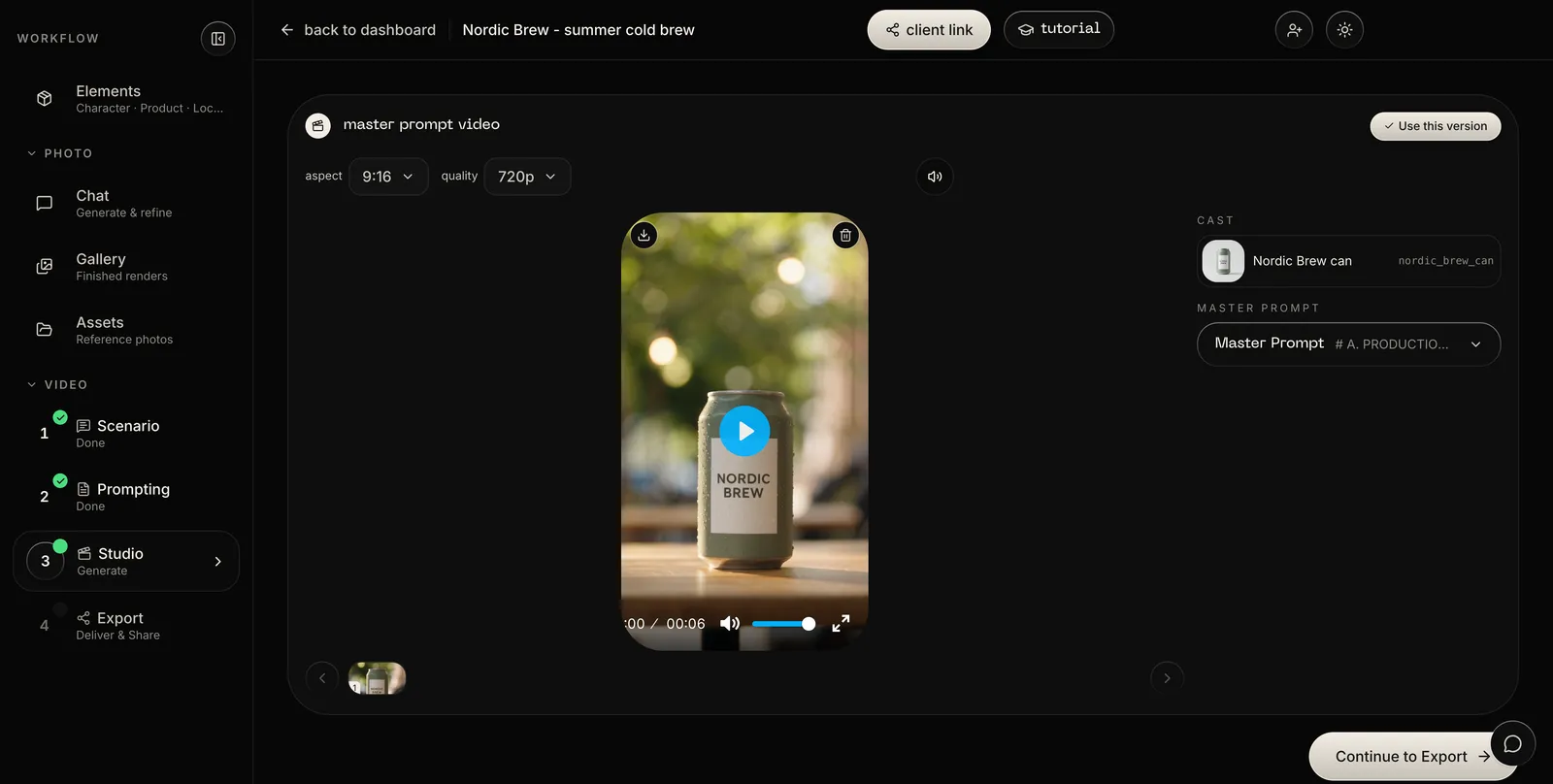
What is a hook in a video ad?
A hook is the first scene of the ad, the moment that decides whether a viewer keeps watching or scrolls on. It is usually the first second or two, and it is the part of the ad that is cheapest to vary.
The rest of the ad can stay the same while the opening changes. That is why hook tests suit AI video: the product scenes, the sound and the closing line are made once, and only the opening is rebuilt for each version.
Why test the hook before anything else?
Test the hook first because a viewer who leaves in the first scene never sees the rest of your work. If two ads share every scene except the opening, any difference in results has one explanation, and that makes the test readable.
I cannot give you a typical lift from a better hook, because I have no number I can stand behind. What I can say is that testing one change at a time is the only way I know to learn something from a small budget.
What should stay the same between versions?
Hold everything except the first scene. When two things change at once, you cannot tell which one moved the result.
- The product and its locked details, such as the color and the label.
- The message and the offer line.
- The sound, if you can keep it identical.
- The ratio and the length.
- The audience and the daily budget in your ad account.
What kinds of hooks can I try?
Try openings that start from different places, not small variations of one idea. Here are four that I would test for a physical product.
- The payoff first: start on the finished result, then show the product.
- The problem first: start on the annoyance the product removes.
- The product close-up: start on the detail a shopper should notice.
- The setting: start on the place where the product lives, with no text.
Pick two or three. A small set that differs on one variable teaches more than a pile of unrelated ads.
How do I build the versions in HubContent?
- Write the brief once, with the product photo and the single message.
- Make the version you like most, with all its scenes.
- Branch it: duplicate the scene list and rewrite only the first scene.
- Generate the new opening for each version and check it against the real product.
- Export each version in the ratio of the placement and name the files so your ad account stays tidy.
Because you reuse the other scenes, the second and third version cost less effort than the first. The AI video ad generator page shows the same flow.
What does a hook test cost?
Count the number of full videos you export and multiply by $5.15, then add a spare take for any scene that shows the product up close.
A test of three versions exports three videos of 15 seconds, each at $5.15, plus whatever retakes your product needs. I cannot tell you how many retakes that will be, because it depends on your product and your brief.
Creator, at $39 a month, grants 3,900 credits, so it fits a few tests a month. The plan page has the details, and the commercial license starts at Creator.
How do I run the test in my ad account?
Put the versions in the same campaign, give them the same budget and audience, and wait until each has had enough views to compare. I will not name a number of views, because it depends on your account and your product.
Decide before you start what you will look at: cost per purchase, cost per click, or how long people watch. Pick one, write it down, and do not change it after you see the numbers.
What mistakes ruin a hook test?
- Changing the hook and the offer together.
- Stopping a version after a few hours because it looks bad.
- Testing five hooks on a budget that can support two.
- Letting a scene drift, so the product looks different in one version and the test measures the drift.
- Reading too much into one result. Run the winner again before you build on it.
The studio does not tell you which version wins. Your account does. A related piece, how many ratios and versions to export, covers the file side of the same job.
How should I name and track the versions?
Name each file with the product, the hook and the ratio, for example the product, a short label for the opening and 9:16. Keep a simple sheet that lists each version, the date you launched it and the result you chose to measure.
It sounds fussy, and it is what lets you answer, three weeks later, which opening you tested and what happened. Memory is a poor record.
What if no hook wins?
Then the hook was not the problem. Look at the message, the offer and the product itself. A test that shows no difference is still a result, and it saves you from building a whole campaign on a variable that did not matter.
I would try one bigger change next, such as a different message, before making more small variations of the opening.
What do I do with the winner?
Keep the winning opening and test the next variable, such as the closing line. Then make a new set of openings in the same style. If you want to see the flow on your own product, the page for brands is the place to start.